Healthy Cats Were Going Blind and Dying of Heart Failure. Nobody Could Explain It. Then One Vet Stumbled on the Answer.
The discovery changed every cat food formula in America. The one thing it didn't change is the thing that matters most.
7 minute read · Updated August 2026
For most of the last century, veterinarians had a problem they could not solve.
Cats would come in — indoor cats, well-fed cats, cats who had never missed a meal or a checkup — and they were going blind. Not from an injury. Not from an infection. Their retinas were quietly breaking down, and by the time anyone noticed, the damage was permanent.
Other cats came in with failing hearts. The heart muscle would stretch thin and weaken until it stopped doing its job. The condition is called dilated cardiomyopathy, or DCM. In cats, it was close to a death sentence. Once it was diagnosed, most lived days to weeks. Not months. Days.
These were not stray or neglected cats. They were loved, indoor cats eating commercial food from brands their owners trusted. The owners had done nothing wrong. The food was supposed to have everything in it.
For decades, that was where it stayed. Unexplained blindness. Unexplained heart failure. No pattern anyone could see.
Then two researchers at the same university, working years apart on different problems, found the same answer.
The Nutrient Nobody Was Looking For
In the 1970s, a nutritionist at UC Davis named Quinton Rogers was studying what cats need in their food. He demonstrated something the pet food industry had not accounted for.
Cats fed diets without enough taurine — a sulfur-containing amino acid found in animal protein — developed progressive retinal degeneration. Their eyes were failing because of something missing from their food. Not something toxic. Not something contaminated. Something absent.
Kittens born to taurine-deficient mothers were often blind from birth, and showed other developmental problems including an impaired gait. Adult cats on taurine-poor diets lost vision gradually, over months, with no behavioral sign an owner would recognize until it was advanced.
That finding explained the blindness. It did not explain the hearts. That would take another decade, and it would happen almost entirely by accident.
Why Cats and Not Dogs
Before we get to 1987, one piece of biology matters, because everything after this depends on it.
Most mammals make their own taurine. Humans do. Dogs do — dogs have no formal dietary taurine requirement at all. Most of the animal kingdom produces enough internally to never need it from food.
Cats cannot. Cats are one of the rare mammals that cannot synthesize enough taurine on their own. They lack the enzyme capacity to produce it in meaningful amounts.
Every bit of taurine a cat needs — for the heart muscle, for the retinas, for bile salts and digestion, for neurological function — has to arrive in the bowl. Plant protein contains none of it. There is no biological backup system.
If the food delivers enough, the cat is fine. If it does not, the damage starts quietly. That is the part that makes this different from most nutrition stories. There is no early warning sign an owner can watch for.
The Accident
In 1987, a veterinarian at UC Davis named Dr. Paul Pion was treating a cat with dilated cardiomyopathy. The cat was dying. There was no established treatment. Nobody knew what caused the condition, and Pion was running out of options.
Working from a hunch informed by Rogers' earlier work on taurine and the retina — with no established connection between taurine and heart function — he tested the cat's blood plasma for taurine.
It was critically low.
He tested more cats with DCM. Every one of them was low.
Then he did the thing that made veterinary history. He supplemented their taurine.
The heart failure reversed. Not slowed. Not managed. Reversed. Hearts that had stretched thin and weakened began to recover. Cats that had been dying started living.
Pion published the finding in Science — not a trade journal, but one of the most prestigious scientific publications in the world. The title was dry: Myocardial failure in cats associated with low plasma taurine: a reversible cardiomyopathy.
The implications were not dry at all. A generation of unexplained feline blindness and heart failure traced back to one missing nutrient.
Before 1976, Nobody Knew
Here is the part almost nobody hears.
Before 1976, taurine was not even classified as an essential nutrient for cats. There was no requirement for any cat food to contain it. None.
In 1981, the National Research Council recommended that cat food contain at least 500 parts per million. Reporting from the time found some foods on shelves contained as little as 250 parts per million — roughly half.
An entire industry was not lying to cat owners. It genuinely did not know. And the cats who paid for that not-knowing belonged to people who had done everything right. They bought the food. They trusted the brand. They went to the vet. They loved their cats every single day.
The Fix
The industry moved quickly after Pion's paper.
AAFCO — the Association of American Feed Control Officials, which sets nutritional standards for pet food sold in the United States — established minimum taurine requirements for all commercial cat food. Dry food: 0.10 percent, or 1,000 mg per kilogram. Wet food: 0.20 percent, or 2,000 mg per kilogram. Roughly 25 mg per 100 kcal for dry, and 50 mg per 100 kcal for canned.
Every formula was updated. Every bag and can was reformulated. Within a few years, taurine-related DCM in cats dropped dramatically.
The system worked. By every official measure, the problem was solved.
And this needs to be said clearly, without hedging: if you are feeding your cat a commercial diet labeled complete and balanced, that food contains taurine. That is true. Anyone who tells you otherwise is not being straight with you.
But there is one more turn in this story.
The Gap Nobody Closed
A minimum requirement and a verified result are two different things.
Turn your cat's food bag around and find the Guaranteed Analysis. That panel is where nutrient content gets reported. It is worth understanding what it actually tells you.
The Guaranteed Analysis reports minimums and maximums, not measured amounts. AAFCO only requires four items on it: crude protein, crude fat, fiber, and moisture. And the figures reflect the recipe — what was calculated or added during formulation — not a test of the finished product.
One veterinary nutrition source put it bluntly: the Guaranteed Analysis "provides no information about the quality or digestibility of the diet. It tells you almost nothing. It's just a really, really poor indicator for nutritional value."
The only real verification is a feeding trial, where a food is tested on actual animals to confirm it performs as claimed. Feeding trials are expensive. Most brands skip them and state only that the food is "formulated to meet AAFCO standards." In one documented case, a popular premium cat food showed 22 erroneous nutrient claims when nine different packages were analyzed.
Now add what happens between the mixer and the bowl.
Taurine is water-soluble and sensitive to heat. Kibble is made by extrusion, at barrel temperatures commonly in the range of 130 to 150 degrees Celsius, with some sources citing peaks above 200. Canned food is sterilized by retort, at temperatures that can exceed 121 degrees Celsius. Cooking water, which a water-soluble nutrient leaches into, is typically discarded.
This is not a conspiracy. It is a mechanical loss pathway that nobody disputes.
There is also evidence that processing affects how well the remaining taurine gets used. In a controlled study using radiolabeled taurine, cats fed heat-processed commercial diets excreted 9.4 percent of the dose as a degraded byproduct. Cats fed frozen, non-heat-processed diets excreted 0.09 percent. The researchers concluded that processing appears to change digestion or absorption in a way that increases how much taurine gets broken down by gut bacteria before the cat can use it.
So: taurine is measured going into the formula. It is not measured coming out of the factory.
That is the gap. Not a scandal, not a cover-up — a measurement system that was built to set a floor and was never extended to check the result.
NinthLife Daily Taurine Powder
- One ingredient: taurine
- 250 mg per level scoop
- Batch-tested after manufacturing
90-day money-back guarantee
What This Does Not Mean
A few things need saying plainly, because this is where most supplement marketing starts overreaching.
Taurine deficiency is not common today in cats eating standard commercial food. Veterinary sources describe it as rare. The 1987 fix largely worked, and pretending otherwise would be dishonest.
Not every expert agrees on how much heat processing matters. At least one nutrition source argues that light cooking does not meaningfully deplete taurine and that only serious overcooking is destructive. That is a fair point and worth knowing.
Your cat food brand is not the villain here, and neither is your vet. If your vet has told you commercial food covers taurine, your vet is describing a defensible clinical position. Nothing in this article contradicts it.
What the article describes is narrower and harder to argue with: nobody is testing the finished product, and for the one nutrient a cat's body cannot produce, that is a variable sitting in your cat's bowl every day with nobody checking it.
Whether that variable is worth removing is your call. It is a small one either way, which is the point.
Why This Gets Louder With Age
Nothing above changes with a cat's age. The biology is the same at two as it is at fourteen.
What changes is the margin.
Older cats often eat less. Appetite drops, meals get left half-finished, and less food means less of everything in it. A minimum calculated for a cat eating a full portion assumes the cat eats the full portion.
Older cats also have less time. Retinal damage does not reverse. Heart damage caught late is a different situation than heart damage caught early. When something progresses quietly, the years you have left to notice it matter.
And there is the part that has nothing to do with biology. If you are reading this, something already made you look. A jump they did not make. A longer nap. A checkup where the vet said fine for their age and you drove home turning that phrase over.
The research on this is consistent, and it is worth naming honestly. The strongest reason people act here is not fear that their cat will die. It is not wanting to find out later that something was preventable and they never looked.
What You Can Actually Do
There is no at-home test for a cat's taurine status. Blood plasma testing exists but runs through your vet, and it is not a routine part of a standard checkup.
That leaves two honest options: do nothing and accept the variable, or remove the variable.
Taurine is one of the few nutrients where removing the variable is genuinely low-stakes. It is water-soluble. The body uses what it needs and passes the rest in urine — it is not stored in tissue. The safety margin is wide, which is why precision and transparency matter more here than a big dose.
If you decide to supplement, three things determine whether it is worth doing at all.
What is actually in the tub. The single most repeated complaint about taurine supplements is filler. Maltodextrin, whey, and flavor carriers are cheaper than taurine, and buyers who read the panel closely have found products where the filler is the primary ingredient. One reviewer put it as clearly as anyone could: "This is a maltodextrin supplement with taurine, not a taurine supplement."
Whether anyone verified it. "Lab-tested" printed on a label is a claim. A dated Certificate of Analysis, with a named third-party lab and a batch number matching the tub in your hand, is a document. Only one of those can be checked.
Whether your cat will eat it. This sounds like the least important factor and it is actually the one that decides everything. Tablets get spat out. Chewables get vomited. Powders with flavor carriers announce themselves to a nose that can detect parts per million. As one owner wrote: "Nothing is worth a cent if the cats won't eat it."
Where NinthLife Comes In
NinthLife exists to close one gap, and only one.
It is pure taurine powder for cats. One ingredient. No maltodextrin, no whey, no flavor carriers, no proprietary blend. The ingredient panel is one word long.
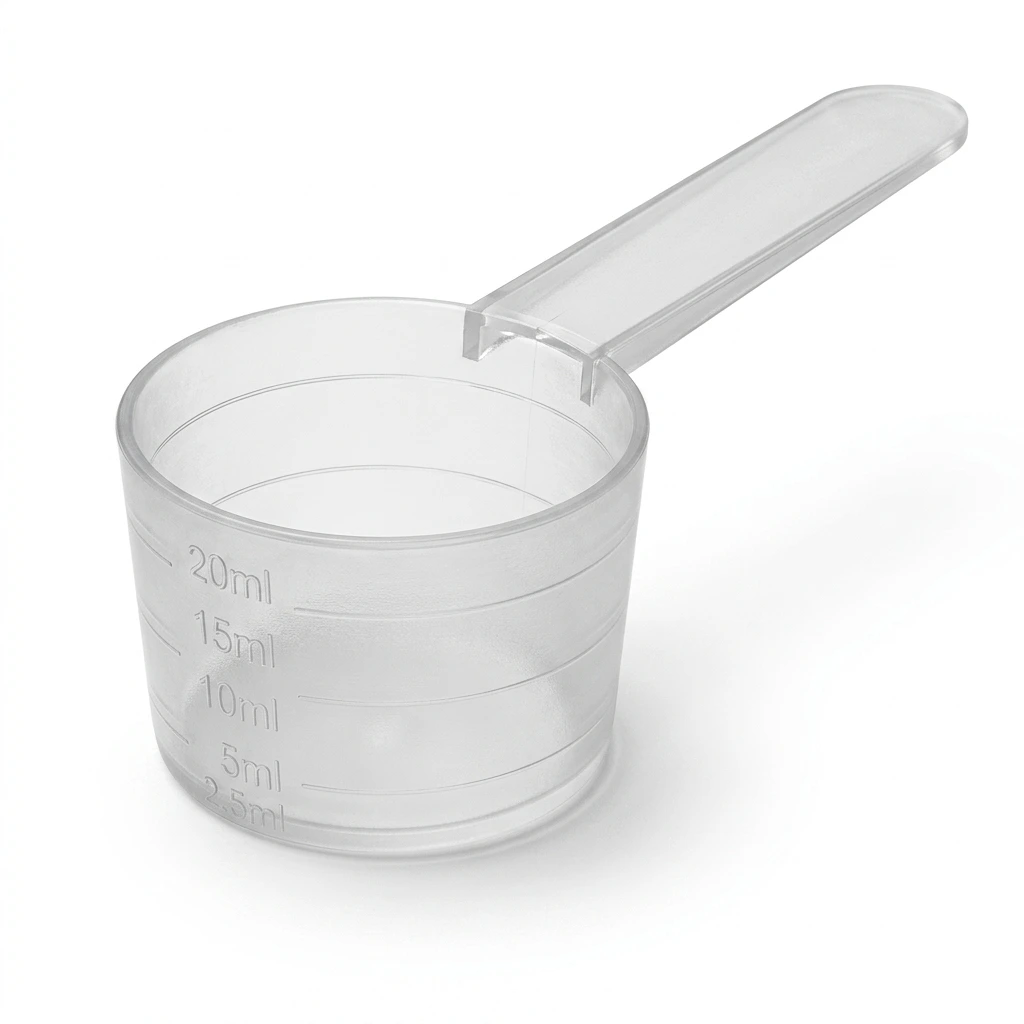
Each level scoop delivers 250 mg, printed on the label, measured with the scoop included in every tub. Thirty servings per tub — about a three-month supply for one cat.
Every batch is tested after manufacturing, by an independent third-party laboratory. Not tested at formulation. Not tested on the incoming raw material only. Tested on the finished product. The Certificate of Analysis is published, dated, and tied to the batch number on the tub you receive.
It has no flavor and no scent. It dissolves completely in wet food. One scoop, stirred in. Most cats eat their food the way they always have and never register that anything changed.
It does not replace your cat's food. It does not ask you to switch brands, or to distrust your vet, or to believe anything you cannot verify yourself.
What We Do Not Claim
NinthLife is a nutritional supplement. It is not a medication and not a treatment.
It does not treat, cure, prevent, or reverse dilated cardiomyopathy, heart murmurs, blindness, retinal degeneration, or any other disease or condition.
We cannot promise what it will do for your specific cat, and we will not pretend otherwise. What we can tell you exactly is what is in the tub, how much is in each scoop, who tested it, and when.
If your cat is on a prescription diet or a veterinary-managed health plan, talk to your vet before adding anything — including this. Your vet knows your cat's situation better than we do.
Questions People Ask
My vet says their food already covers taurine. Is this necessary?
Your vet is right that commercial foods are formulated with taurine. What NinthLife addresses is narrower: the difference between what is added at formulation and what survives heat processing into the finished product. The Guaranteed Analysis reports a minimum set during mixing, not a verified measurement of what is in the bag. This does not replace your vet's guidance. It closes a gap your vet is not testing for.
Can they get too much?
Taurine is water-soluble. The body uses what it needs and excretes the rest — it is not stored in tissue. The safety margin is wide. Each scoop contains exactly 250 mg. If you have concerns, bring this page to your vet; the dose is printed clearly.
How long before I notice anything?
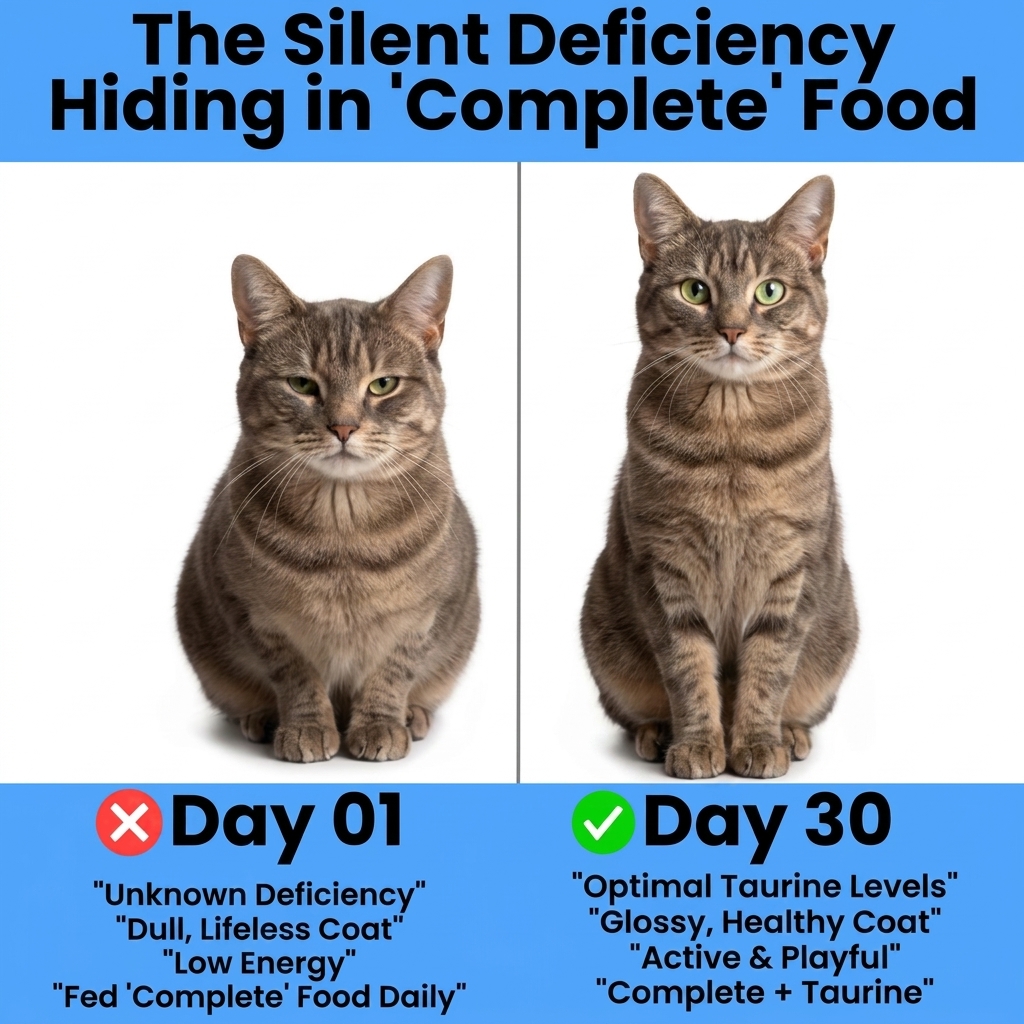
Some owners report changes in energy, appetite, or coat within two to three weeks. Some never see a visible change and continue for the peace of mind. Independent reviewer timeframes range widely. We would rather set your expectations at gradual and subtle than promise you something dramatic on a schedule.
What if they won't eat it?
It is tasteless, odorless, and dissolves completely in wet food. Most cats eat with no awareness anything changed. If yours is the rare exception, the 90-day guarantee covers you — including "they wouldn't eat it" as a reason.
The Close
For decades, cats went blind and died of heart failure and nobody could say why. Two researchers found the answer. The industry set a minimum and fixed the recipe.
It never started verifying the result.
That is the whole story, and it is the entire reason this product exists. One ingredient. One scoop. Tested after it is made, with the paperwork published where you can read it.
If it turns out your cat did not need it, you have lost very little. If it turns out they did, you have handled something you cannot go back and fix later.
NinthLife Daily Taurine Powder
- One ingredient: taurine
- 250 mg per level scoop
- Batch-tested after manufacturing
90-day money-back guarantee